![[personal profile]](https://www.dreamwidth.org/img/silk/identity/user.png) smackenzie
smackenzieIt's a little exhilarating, in fact, to stand in a trench at last and feel like you're actually part of the war.
Nothing happens, though, and at sunrise they stand down, eat breakfast (the hardest biscuits Davies has ever had in his life, plus jam, nearly-cold porridge, and tea that tastes almost but not quite like he thinks it should), and then Captain Bradford and his second in command pass through the trench again, handing out work and sentry assignments.
They stop in front of Davies and Powell, who both stand to attention. Captain Bradford seems about to say something, then turns to his second in command – Davies now remembers that this officer is another captain, name of Armstrong – who whispers something to him. Davies is offended that his captain doesn't even know his name.
"Mr Davies, Mr Powell," Captain Bradford says, nodding his head at each of them in turn. "You'll be shoring up the trenches for the next few hours with the rest of your platoon. Sergeant Fiske should be right behind me. Mr Morehouse," he adds to the man standing next to Davies, "you've drawn sentry duty."
"How exciting," Morehouse says to Davies after the commanders have walked on. He sounds sincere. Davies can understand. He builds walls for a living, and getting to stand at the parapet and watch for signs of moving Germans sounds genuinely interesting. Even more exciting would be to get assigned as part of a listening party and spend some time hiding in a sap, one of the short, shallow trenches dug straight out from the front-line trench, listening for German movements and positions.
"Better than stacking sandbags," Powell mutters. "But at least it's something we know how to do."
Sergeant Fiske leads them and the rest of the platoon down a muddy communication trench to the support trench, where he hands Davies and Powell and ten other men over to yet another NCO – Davies is pretty sure he's another platoon leader – who shows them the sliding trench wall and gives them their orders.
They spend the next few hours moving down the trench, shoveling the chalky earth, filling sandbags, and stacking them up like giant canvas bricks so that this part of the trench won't collapse on itself. It's hard, muddy work, and after some initial chatter, the men fall mostly silent. Davies thinks his mum would be so disappointed in him – all this way to France to fight for God and England, and he's building a wall. It makes him chuckle.
"Glad someone's amused," mutters Powell. He's covered in chalky mud to the shoulders. He sneezes, wipes the back of his hand across his nose, and leaves a smear of mud on his face. Davies snickers. "Shut up."
"You have mud on your face, mate," someone says from behind Davies. The guy must be looking over his shoulder.
"Well what am I going to wipe it off with? Everything's covered with dirt."
Davies flips up the hem of his tunic enough to find a dry and mostly clean spot on the inside, wipes his own hand off on the fabric, and swipes it across Powell's face. Powell looks irritated. The private standing behind Davies laughs.
"No slacking off," snaps an officer, coming up to them with his rifle slung over his shoulder. His clothes are remarkably clean. "Back to work."
"He's not covered in mud," Powell observes after he moves off.
"He's an officer," Davies says. "They don't have to dirty their hands." Captain Bradford looked remarkably well-pressed for a man who'd spent the night in a wet, muddy trench.
They shift down a few feet to continue filling and stacking their sandbags. Trenches aren't built in straight lines, and the support trench meanders around corners in ways that make it hard to shore up evenly. Davies thinks of his dad talking about many hands making the work light. He likes the other men in his platoon and he could be doing worse things than this, so in that sense he guesses his dad is right. The work is still demanding and unpleasant, but at least he has his own people around him.
They're sent back to the front-line trench after a while and told to get some rest before dinner and beware of the rats.
Morehouse hasn't moved. Davies climbs up onto the step next to him and whispers "See anything?" Morehouse jumps.
"Christ, man, don’t do that," he says, sounding rattled. "Scared me."
"Sorry."
"Your answer's no, anyway. Nothing interesting, at any rate. I can't see anyone along the line of their trench." He gestures at the barbed wire in front of the parapet, evidently indicating Davies should look through the angry tangle to the far side of No Man's Land. "See that kind of scribble? That's the barbed wire on their side." Davies squints. The sky is overcast and the light is flat, but there's still a glare that makes it hard to see. Now that it's day he can see some of the ground between the British line and the German line – No Man's Land – it's cratered and muddy and desolate and forbidding. The sun reflects silver off the rainwater in the craters, which he guesses were made by falling shells or mortars, making it look as if the craters are filled with mercury. But the Germans aren't that far away.
"Keep your heads down." Sergeant Fiske says behind them. Morehouse doesn't jump this time. "The Huns are watching us just as much as we're watching them. Might see some action after dark."
"They're going to shoot at us in the dark?" Powell asks. He sounds doubtful. "Sir," he adds, remembering that he's talking to a superior officer.
"Sometimes during the day, too." Sergeant Fiske either didn't catch the familiarity or doesn't care. "Keep your wits about you."
"We were told to get some rest, sir."
"So rest. Stay sharp, Mr Morehouse."
He walks on, talking to anyone who's still awake. Davies settles on the step next to Morehouse. There are fewer sentries posted during the day, so there's room now to lie down, although he can't stretch out. He wouldn't have thought he could sleep on a damp stretch of dirt and sandbag, but shoring up the support trench wiped him out, and the next thing he knows, Morehouse is shaking his shoulder and Captain Bradford is standing over him.
"Mr Davies," he says, sounding more amused than anything else. "Would that we all slept as deeply."
"Sir," Davies says uncertainly. Is his battalion commander laughing at him?
"Sergeant Fiske tells me you did a quick job on the support trench. Good work."
"Thank you, sir." Maybe not laughing after all. The captain certainly looks sincere, although Davies knows that the upper classes can dissemble just as easily as anyone. But he has had limited experience with army commanders, and for all he knows, they're taught to be nice to their men and generous with compliments. Captain Bradford came to France on the same steamer he did, he knows, and marched the same distance in the same rain. He doesn't have any more experience with this war than Davies does. And so far, aside from Sergeant Fiske and the quartermaster who yelled at him for asking for some writing paper, he's really the only commanding officer Davies knows.
"Might I suggest you make sure your rifle is cleaned properly?" The way he says it, it sounds more like a friendly suggestion than a command, but Davies isn't fooled. He slept through when other men would be making sure their equipment was in good condition. (Well, except for Morehouse and the other sentries, who are too busy waiting to use their rifles to stop watching No Man's Land long enough to clean them.)
"Yes, sir." Davis resists the urge to salute. Then Captain Bradford steps around him, climbs onto the step next to Morehouse, and asks if he has anything to report.
Didn’t Sergeant Fiske tell you he hasn't seen anything? Davies wonders. But it looks as if Morehouse and the captain are having an actual conversation. How odd. Davies hadn't thought company commanders would be that interested in their men.
Captain Bradford climbs back down from the step, nods to Davies – who does salute this time – and continues down the trench.
"What did he say to you?" Davies asks Morehouse.
"Just wanted to know what I'd seen and if I thought the Germans would attack tonight. Can't believe a superior officer asked me for advice."
"What did you tell him?"
"Same thing I told you. Haven't seen anything worth reporting. Just their barbed wire." He shrugs. "He said someone would be by to relieve me after dinner."
"Huh." Davies sits on the step, wonders briefly where Powell got to, and attends to his rifle. It isn't as muddy as the rest of him, and he hasn't fired it except during training, and before he joined the army he really didn't know anything about firearms, much less military rifles, but he's had it drilled into him to keep it clean and in the best condition possible. He can probably recite the various steps needed to take care of it in his sleep.
Powell appears maybe twenty minutes later, still covered in mud but looking rested. He explains he bunked down in a funk hole – basically a shelter half dug out of the trench wall - and he's not sure he'd recommend it, even if he did manage a few good hours of sleep. And at least he didn't see any –
"Good Christ!" he exclaims, as a rat appears out of nowhere and runs over their boots.
"You didn't see any rats, huh," Davies says. He doesn't like rats but he knows how to deal with them. When he writes home, he'll ask his dad to send him some of the rat poison the bricklayers use to keep the damn things away from building sites.
Or he could just throw things at them, as Powell does now with an empty corned beef tin.
Someone does indeed come to relieve Morehouse after dinner (which is a lot like breakfast, except that they have corned beef rather than porridge, and no jam), and as dusk falls they stand to again. All the men have been warned that they have to stand to at dawn and dusk because that's when the Germans are most likely to attack. In the waning light everything in No Man's Land looks indistinct and hardly real, and Davies can just imagine the Germans charging across the pockmarked distance like a battalion's worth of ghosts, unrecognizable as living people until they're too close.
He doesn't believe in ghosts. Anything he sees moving out there is definitely going to be a living creature, and unless he's absolutely sure it's one of his own, he's going to shoot at it.
There's no shooting right then, though. Full dark falls without incident, and Davies gets assigned to a listening party with an NCO and another private from a different platoon. They crouch at the end of a shallow listening trench – the sap – the farthest they can get from the front-line trench without actually climbing over the parapet. The NCO has a periscope, but Davies and the other private can only sit and listen. They can hear rats scuttling around, but nothing from their own front-line trench. But that makes sense, as the sap is thirty yards long, and they're sitting at the end of it, and the rest of their battalion is trying to be as quiet as possible. But they hear nothing from the Germans either. Davies is both very excited and a little bored.
Yet there's something a little nerve-wracking about hunkering down at the end of a listening trench in the darkness of the front, trying to figure out what the enemy is doing at the same time you're trying to keep him from learning anything about you. Davies looks up in time to see the faint outlines of two men creeping along the tangle of barbed wire closer to the front-line trench, no doubt intending to repair any breaks or to roll out more wire. If they were going out on reconaissance to get up close and personal with the German line, they'd be on their stomachs, crawling across No Man's Land as stealthily as possible, like snakes.
He wants to do that. He wants to do something.
The NCO nudges him. "Take a look," he whispers, gesturing to the periscope and sliding out of the way. Davies takes his place and peers through it, seeing nothing at first but vague shapes in varying shades of dark. "What do you see?"
"Just shapes, sir." Davies is whispering so quietly he can barely hear himself. "I can't tell if they're people or not."
"Keep watching."
So Davies does, turning the periscope from side to side so he can scan the land in front of him. There's another sap farther down the trench, he knows, but he can't see it and doesn't think the men sitting the end of it, if they have a periscope too, can see the exact same things he can. He wants the widest view possible.
He eventually has to hand the periscope off to the other private, and is back to listening with the NCO. Everything is quiet. A little tense, because of the darkness and the nature of this particular job, but quiet. Davies guesses he should be thankful they're not being shelled to death, or overrun by Germans. Still, he wouldn't mind a bit more excitement. He'd have thought that being on the front lines would be more... active.
words: 2211
total words: 8068
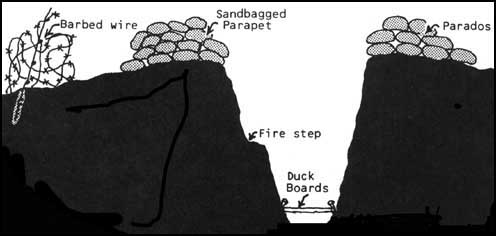
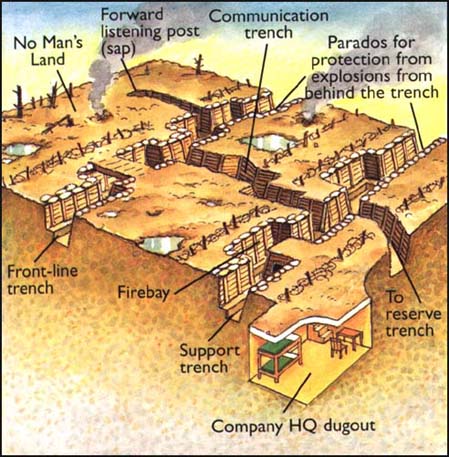
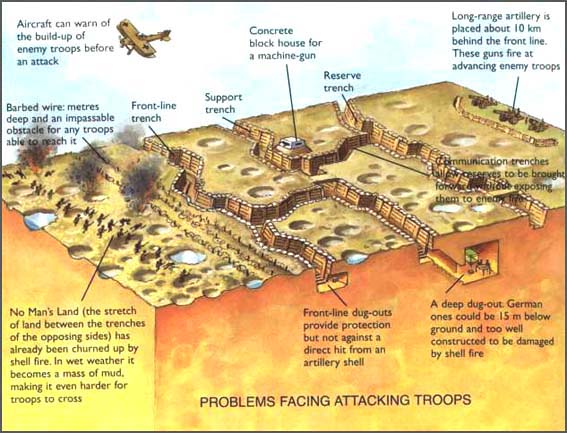
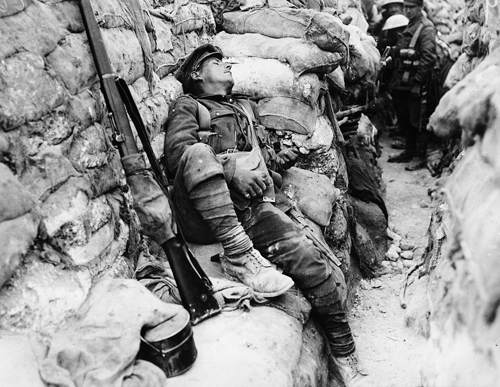
note: i highly doubt a soldier with any sense would actually stick his head above the line of the trench parapet and wave at the barbed wire in the middle of the day, when an enemy sniper could see him well enough to take a potshot at him. just imagine the germans are asleep in that particular section of their trench. also, have some pictures: side view of a trench, trench system diagram, another one, and a soldier napping on the fire step.
Nothing happens, though, and at sunrise they stand down, eat breakfast (the hardest biscuits Davies has ever had in his life, plus jam, nearly-cold porridge, and tea that tastes almost but not quite like he thinks it should), and then Captain Bradford and his second in command pass through the trench again, handing out work and sentry assignments.
They stop in front of Davies and Powell, who both stand to attention. Captain Bradford seems about to say something, then turns to his second in command – Davies now remembers that this officer is another captain, name of Armstrong – who whispers something to him. Davies is offended that his captain doesn't even know his name.
"Mr Davies, Mr Powell," Captain Bradford says, nodding his head at each of them in turn. "You'll be shoring up the trenches for the next few hours with the rest of your platoon. Sergeant Fiske should be right behind me. Mr Morehouse," he adds to the man standing next to Davies, "you've drawn sentry duty."
"How exciting," Morehouse says to Davies after the commanders have walked on. He sounds sincere. Davies can understand. He builds walls for a living, and getting to stand at the parapet and watch for signs of moving Germans sounds genuinely interesting. Even more exciting would be to get assigned as part of a listening party and spend some time hiding in a sap, one of the short, shallow trenches dug straight out from the front-line trench, listening for German movements and positions.
"Better than stacking sandbags," Powell mutters. "But at least it's something we know how to do."
Sergeant Fiske leads them and the rest of the platoon down a muddy communication trench to the support trench, where he hands Davies and Powell and ten other men over to yet another NCO – Davies is pretty sure he's another platoon leader – who shows them the sliding trench wall and gives them their orders.
They spend the next few hours moving down the trench, shoveling the chalky earth, filling sandbags, and stacking them up like giant canvas bricks so that this part of the trench won't collapse on itself. It's hard, muddy work, and after some initial chatter, the men fall mostly silent. Davies thinks his mum would be so disappointed in him – all this way to France to fight for God and England, and he's building a wall. It makes him chuckle.
"Glad someone's amused," mutters Powell. He's covered in chalky mud to the shoulders. He sneezes, wipes the back of his hand across his nose, and leaves a smear of mud on his face. Davies snickers. "Shut up."
"You have mud on your face, mate," someone says from behind Davies. The guy must be looking over his shoulder.
"Well what am I going to wipe it off with? Everything's covered with dirt."
Davies flips up the hem of his tunic enough to find a dry and mostly clean spot on the inside, wipes his own hand off on the fabric, and swipes it across Powell's face. Powell looks irritated. The private standing behind Davies laughs.
"No slacking off," snaps an officer, coming up to them with his rifle slung over his shoulder. His clothes are remarkably clean. "Back to work."
"He's not covered in mud," Powell observes after he moves off.
"He's an officer," Davies says. "They don't have to dirty their hands." Captain Bradford looked remarkably well-pressed for a man who'd spent the night in a wet, muddy trench.
They shift down a few feet to continue filling and stacking their sandbags. Trenches aren't built in straight lines, and the support trench meanders around corners in ways that make it hard to shore up evenly. Davies thinks of his dad talking about many hands making the work light. He likes the other men in his platoon and he could be doing worse things than this, so in that sense he guesses his dad is right. The work is still demanding and unpleasant, but at least he has his own people around him.
They're sent back to the front-line trench after a while and told to get some rest before dinner and beware of the rats.
Morehouse hasn't moved. Davies climbs up onto the step next to him and whispers "See anything?" Morehouse jumps.
"Christ, man, don’t do that," he says, sounding rattled. "Scared me."
"Sorry."
"Your answer's no, anyway. Nothing interesting, at any rate. I can't see anyone along the line of their trench." He gestures at the barbed wire in front of the parapet, evidently indicating Davies should look through the angry tangle to the far side of No Man's Land. "See that kind of scribble? That's the barbed wire on their side." Davies squints. The sky is overcast and the light is flat, but there's still a glare that makes it hard to see. Now that it's day he can see some of the ground between the British line and the German line – No Man's Land – it's cratered and muddy and desolate and forbidding. The sun reflects silver off the rainwater in the craters, which he guesses were made by falling shells or mortars, making it look as if the craters are filled with mercury. But the Germans aren't that far away.
"Keep your heads down." Sergeant Fiske says behind them. Morehouse doesn't jump this time. "The Huns are watching us just as much as we're watching them. Might see some action after dark."
"They're going to shoot at us in the dark?" Powell asks. He sounds doubtful. "Sir," he adds, remembering that he's talking to a superior officer.
"Sometimes during the day, too." Sergeant Fiske either didn't catch the familiarity or doesn't care. "Keep your wits about you."
"We were told to get some rest, sir."
"So rest. Stay sharp, Mr Morehouse."
He walks on, talking to anyone who's still awake. Davies settles on the step next to Morehouse. There are fewer sentries posted during the day, so there's room now to lie down, although he can't stretch out. He wouldn't have thought he could sleep on a damp stretch of dirt and sandbag, but shoring up the support trench wiped him out, and the next thing he knows, Morehouse is shaking his shoulder and Captain Bradford is standing over him.
"Mr Davies," he says, sounding more amused than anything else. "Would that we all slept as deeply."
"Sir," Davies says uncertainly. Is his battalion commander laughing at him?
"Sergeant Fiske tells me you did a quick job on the support trench. Good work."
"Thank you, sir." Maybe not laughing after all. The captain certainly looks sincere, although Davies knows that the upper classes can dissemble just as easily as anyone. But he has had limited experience with army commanders, and for all he knows, they're taught to be nice to their men and generous with compliments. Captain Bradford came to France on the same steamer he did, he knows, and marched the same distance in the same rain. He doesn't have any more experience with this war than Davies does. And so far, aside from Sergeant Fiske and the quartermaster who yelled at him for asking for some writing paper, he's really the only commanding officer Davies knows.
"Might I suggest you make sure your rifle is cleaned properly?" The way he says it, it sounds more like a friendly suggestion than a command, but Davies isn't fooled. He slept through when other men would be making sure their equipment was in good condition. (Well, except for Morehouse and the other sentries, who are too busy waiting to use their rifles to stop watching No Man's Land long enough to clean them.)
"Yes, sir." Davis resists the urge to salute. Then Captain Bradford steps around him, climbs onto the step next to Morehouse, and asks if he has anything to report.
Didn’t Sergeant Fiske tell you he hasn't seen anything? Davies wonders. But it looks as if Morehouse and the captain are having an actual conversation. How odd. Davies hadn't thought company commanders would be that interested in their men.
Captain Bradford climbs back down from the step, nods to Davies – who does salute this time – and continues down the trench.
"What did he say to you?" Davies asks Morehouse.
"Just wanted to know what I'd seen and if I thought the Germans would attack tonight. Can't believe a superior officer asked me for advice."
"What did you tell him?"
"Same thing I told you. Haven't seen anything worth reporting. Just their barbed wire." He shrugs. "He said someone would be by to relieve me after dinner."
"Huh." Davies sits on the step, wonders briefly where Powell got to, and attends to his rifle. It isn't as muddy as the rest of him, and he hasn't fired it except during training, and before he joined the army he really didn't know anything about firearms, much less military rifles, but he's had it drilled into him to keep it clean and in the best condition possible. He can probably recite the various steps needed to take care of it in his sleep.
Powell appears maybe twenty minutes later, still covered in mud but looking rested. He explains he bunked down in a funk hole – basically a shelter half dug out of the trench wall - and he's not sure he'd recommend it, even if he did manage a few good hours of sleep. And at least he didn't see any –
"Good Christ!" he exclaims, as a rat appears out of nowhere and runs over their boots.
"You didn't see any rats, huh," Davies says. He doesn't like rats but he knows how to deal with them. When he writes home, he'll ask his dad to send him some of the rat poison the bricklayers use to keep the damn things away from building sites.
Or he could just throw things at them, as Powell does now with an empty corned beef tin.
Someone does indeed come to relieve Morehouse after dinner (which is a lot like breakfast, except that they have corned beef rather than porridge, and no jam), and as dusk falls they stand to again. All the men have been warned that they have to stand to at dawn and dusk because that's when the Germans are most likely to attack. In the waning light everything in No Man's Land looks indistinct and hardly real, and Davies can just imagine the Germans charging across the pockmarked distance like a battalion's worth of ghosts, unrecognizable as living people until they're too close.
He doesn't believe in ghosts. Anything he sees moving out there is definitely going to be a living creature, and unless he's absolutely sure it's one of his own, he's going to shoot at it.
There's no shooting right then, though. Full dark falls without incident, and Davies gets assigned to a listening party with an NCO and another private from a different platoon. They crouch at the end of a shallow listening trench – the sap – the farthest they can get from the front-line trench without actually climbing over the parapet. The NCO has a periscope, but Davies and the other private can only sit and listen. They can hear rats scuttling around, but nothing from their own front-line trench. But that makes sense, as the sap is thirty yards long, and they're sitting at the end of it, and the rest of their battalion is trying to be as quiet as possible. But they hear nothing from the Germans either. Davies is both very excited and a little bored.
Yet there's something a little nerve-wracking about hunkering down at the end of a listening trench in the darkness of the front, trying to figure out what the enemy is doing at the same time you're trying to keep him from learning anything about you. Davies looks up in time to see the faint outlines of two men creeping along the tangle of barbed wire closer to the front-line trench, no doubt intending to repair any breaks or to roll out more wire. If they were going out on reconaissance to get up close and personal with the German line, they'd be on their stomachs, crawling across No Man's Land as stealthily as possible, like snakes.
He wants to do that. He wants to do something.
The NCO nudges him. "Take a look," he whispers, gesturing to the periscope and sliding out of the way. Davies takes his place and peers through it, seeing nothing at first but vague shapes in varying shades of dark. "What do you see?"
"Just shapes, sir." Davies is whispering so quietly he can barely hear himself. "I can't tell if they're people or not."
"Keep watching."
So Davies does, turning the periscope from side to side so he can scan the land in front of him. There's another sap farther down the trench, he knows, but he can't see it and doesn't think the men sitting the end of it, if they have a periscope too, can see the exact same things he can. He wants the widest view possible.
He eventually has to hand the periscope off to the other private, and is back to listening with the NCO. Everything is quiet. A little tense, because of the darkness and the nature of this particular job, but quiet. Davies guesses he should be thankful they're not being shelled to death, or overrun by Germans. Still, he wouldn't mind a bit more excitement. He'd have thought that being on the front lines would be more... active.
words: 2211
total words: 8068
note: i highly doubt a soldier with any sense would actually stick his head above the line of the trench parapet and wave at the barbed wire in the middle of the day, when an enemy sniper could see him well enough to take a potshot at him. just imagine the germans are asleep in that particular section of their trench. also, have some pictures: side view of a trench, trench system diagram, another one, and a soldier napping on the fire step.


![[identity profile]](https://www.dreamwidth.org/img/silk/identity/openid.png)
no subject
Date: 2012-11-07 02:14 am (UTC)no subject
Date: 2012-11-08 06:55 am (UTC)